


Summer 2026 recap: New England power grid operates reliably through multiple hot spells

New England’s power grid operated reliably this summer through multiple periods of high temperatures, wildfire smoke, and even a partial solar eclipse.
The region consumed 31,278 gigawatt-hours (GWh) of electricity in June, July, and August. That was less than 1% higher than the energy consumption in summer 2025. Both summers had average temperatures around 71 degrees Fahrenheit (°F) and were less than a degree above normal for the season.1
A heat wave from July 1 to 3, 2026, brought what is likely to be the highest electricity demand for the year, reaching 25,361 megawatts (MW) around 7 p.m. on Thursday, July 2. That was roughly in line with the ISO’s pre-summer projection for normal peak weather conditions. The region used approximately 479 GWh of electricity that day.
The heat wave was the hottest three-day period since June 23-25, 2025, with an average high temperature of 93.4°F. That surpassed the 92.8°F average recorded during the hottest three-day stretch of the June 2025 heat wave. June 24, 2025, remains the hottest individual day since at least 2012, at 97°F. That day also brought peak demand and energy use for 2025, at 26,024 MW and 493 GWh respectively.
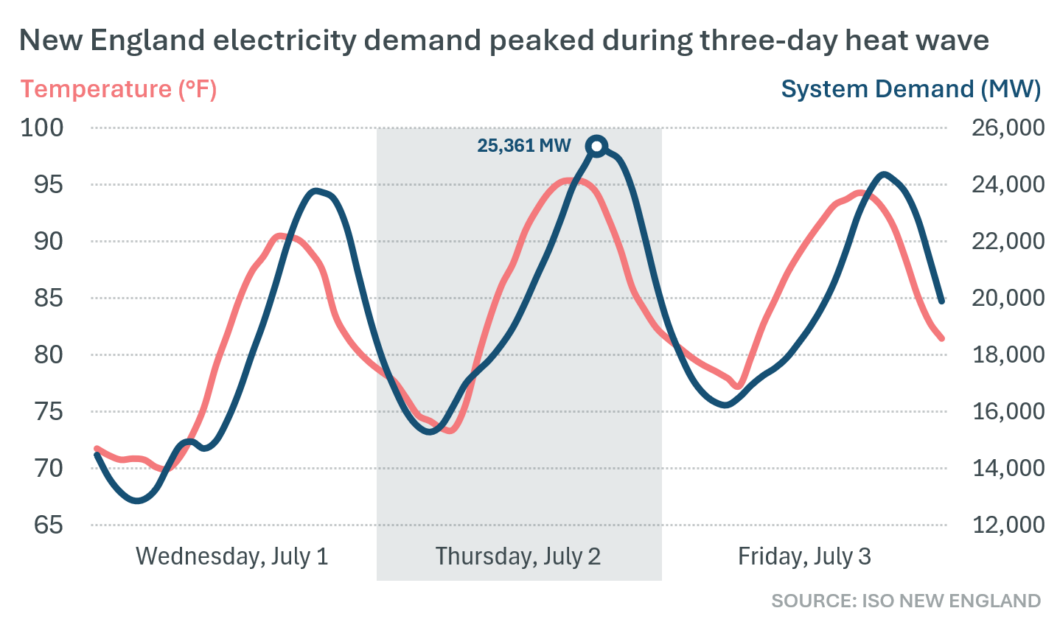
During this summer’s heat wave, ISO New England issued an abnormal conditions alert at 5 p.m. on July 1 in anticipation of tight operating conditions the next day. Generation resources performed well July 2, with minimal outages or reductions in output. The ISO canceled the abnormal conditions alert at 10 p.m.
High temperatures prompted the ISO to issue abnormal conditions alerts three other times this year, on May 19, June 11, and Aug. 7. In each case, high temperatures and humidity drove high demand. Although reserve surpluses were limited, the region’s generation fleet performed well, and the ISO’s highly trained control room staff successfully maintained power system reliability throughout each event.
Wildfire smoke, eclipse briefly reduce solar output
In mid-July, an unusual weather pattern carried thick smoke from wildfires in western and central Canada to New England. The sunlight-blocking smoke created challenges in forecasting electricity demand, but did not impact power system reliability.
The smoke had a two-fold impact on consumer demand for grid electricity. First, it lowered temperatures by up to 15°F in some areas, which had the effect of reducing the need for energy-intensive air conditioning. It also reduced production from behind-the-meter (BTM) solar resources, which had the effect of boosting the need for grid electricity.
At times on July 15 and 16, the ISO estimates that the smoke reduced electricity production from solar resources by up to 50%, or more than 3,000 MW.
A partial solar eclipse on the afternoon of Aug. 12 temporarily reduced BTM solar generation by 550-600 MW, the ISO estimates.
- Temperatures are based on a weighted average of readings from 23 cities around New England. “Normal” temperatures are based on 30 years of historical data. ↩︎
- Categories
- Inside ISO New England
- Tags
- summer, system operations