


ISO-NE team turns ideas into practical solutions
Keeping the New England’s bulk power system reliable has always required a careful balance of technology and human expertise. The challenge is growing in complexity as weather becomes less predictable, the energy resource mix evolves, and the grid is asked to do more than ever before.
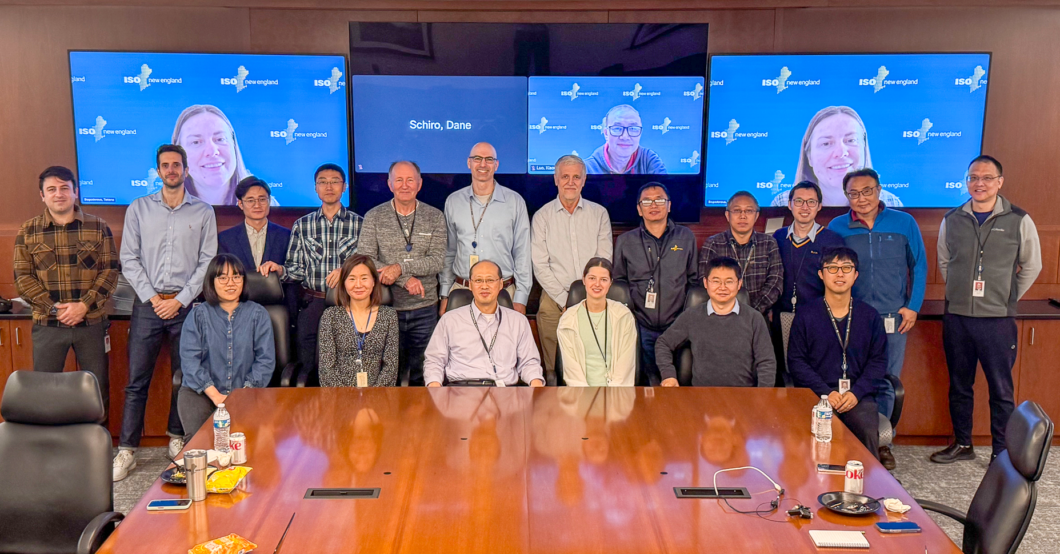
Behind many of the tools ISO New England uses to meet these challenges is a small, innovative group with a big impact. Advanced Technology Solutions (ATS) is the in-house innovation team, focusing on cutting-edge research and development to address some of the organization’s most complex challenges.
ATS supports the company’s three critical roles: operating the grid, administering the wholesale electricity markets, and planning the future power system. It does this by providing rigorous analytical frameworks and developing one-of-a-kind innovative solutions and engineering tools. The team’s work touches nearly every major initiative at ISO-NE, from preparing for extreme weather events to redesigning the capacity market.
“The mission is bringing innovation and new technology to the organization to improve reliability and efficiencies,” said Tongxin Zheng, chief technologist. “Technology is a way to achieve the solution, but it’s always about the solution.”
ATS is made up of about 20 experts across three domains: Market Solutions and Optimization Technology, Market Simulation, and Power System Technology.
“Our job is to take complex and innovative ideas and turn them into practical tools the organization can rely on,” said Jinye Zhao, technical manager. “We focus on the needs of ISO and the region, and work closely across departments to make sure what we develop makes a real difference.”
In recent years there has been a focus regionally on energy adequacy during extreme weather events, such as prolonged cold snaps and heat waves. Stakeholders wanted to know what kind of impact these conditions might have on system operations. That need prompted the development of the Probabilistic Energy Adequacy Tool (PEAT), with ATS playing a key role alongside internal and external partners. A state-of-the-art modeling tool, PEAT enables the organization to quantify the risk of energy shortfalls under a wide range of future scenarios.
To turn PEAT’s probabilistic insights into a clear signal for extreme risk, ATS served as a driving force behind the development of Regional Energy Shortfall Threshold (REST). REST focuses on the riskiest 0.25% of simulated scenarios — extremely rare conditions that could have significant consequences for the region if they occur. Together, PEAT and REST help the region assess whether the grid has sufficient energy to meet electricity demand during extreme weather conditions.
Used operationally for the first time during the winter of 2025/2026, this type of probabilistic energy adequacy assessment is the first of its kind in the energy industry and has set the standard for the industry.
The ATS team’s expertise also has been crucial to the Capacity Auction Reforms key project, one of the largest market initiatives ISO New England has undertaken for years.
The reforms are designed to transform the capacity market by introducing a prompt and seasonal auction structure, along with accreditation reforms that better align resources compensation with their actual contributions to resource adequacy. Introduced by the ATS team, the marginal reliability impact (MRI) concept has become the foundation of the new accreditation framework. This effort requires both complex market design and sophisticated software implementation, an example to show how teams inside ATS collaborate.
The ATS Market Solutions and Optimization Technology team, managed by Feng Zhao, developed the core design of accreditation processes. Meanwhile, the Market Simulation Team, led by Izudin Lelic, maintains and enhances the capacity market clearing engine itself, ensuring that proposed changes can move from concept to implementation. It also developed the Integrated Market Simulator, a research tool for studying the impact of new electricity market designs.
“My group helps get designs from paper to reality,” Lelic said. “And we often build prototypes or proof‑of‑concept tools so people can see how things will work before they’re finalized.”
In the end, these are all tools for better-informed decision making.
“We may not have a crystal ball to predict exactly how changes will unfold in the real world,” Jinye Zhao said. “But we do have high-quality data and advanced simulation tools. By modeling how different designs or policies might perform, decisions are not made just by intuition, but are supported by a clear understanding of tradeoffs.”
ATS is also exploring how emerging technologies such as machine learning and generative artificial intelligence can support the ISO’s mission. Recent pilot tests have included tools to assist with forecasting, automating elements of report generation, and improving access to enterprise information.
Frankie Zhang, supervisor, Emerging Technologies, said one thing that sets ATS solutions apart from off-the-shelf products is how personalized the work is.
“We use technology to target the exact pain points of our customers,” said Zhang. “The result is a precise solution built for their needs. That’s what makes our approach unique.”
New England’s power system will continue to evolve, and the challenges facing grid operators will become more complex. That’s just the nature of things. Thankfully, the Advanced Technology Solutions team is here to help.
“We can’t succeed by ourselves,” said Zhang. “We’re enablers. Our success comes from working with our customers and helping them solve real problems.”
- Categories
- Features & Interviews
- Tags
- innovation