


Monthly wholesale electricity prices and demand in New England, February 2026

Wholesale power prices averaged $127.38 per megawatt-hour (MWh) in the Real-Time Energy Market in February 2026, up 1% compared to the previous year.1 Day-Ahead Energy Market averages were $126.09/MWh, down 3% from February 2025.
By the numbers
| February 2026 and Percent Change from February 2025 and January 2026 | February 2026 | February 2025 | January 2026 |
| Average Real-Time Electricity Price ($/megawatt-hour) | $127.38 | 0.8% | −17.7% |
| Average Natural Gas Price ($/MMBtu) | $14.31 | −2.1% | −41.0% |
| Peak Demand | 20,178 MWs | 7.5% | −0.2% |
| Total Electricity Use | 10,368 GWh | 4.1% | −10.8% |
| Weather-Normalized Use2 | 10,046 GWh | 1.0% | −11.7% |
Drivers of wholesale electricity prices
In general, the two main drivers of wholesale electricity prices in New England are the cost of fuel used to produce electricity and consumer demand.
Power plant fuel
Fuel is typically one of the major input costs in producing electricity. Natural gas is the predominant fuel in New England, used to generate 54% of the power produced in 2025 by New England’s power plants, and natural-gas-fired power plants usually set the price of wholesale electricity in the region. As a result, average wholesale electricity prices are closely linked to natural gas prices.
The average natural gas price during February was $14.31 per million British thermal units (MMBtu).3 The price was down 2% from the February 2025 average Massachusetts natural gas index price of $14.62/MMBtu. The Mass. index price is a volume-weighted average of trades at four natural gas delivery points in Massachusetts, including two Algonquin points, the Tennessee Gas Pipeline, and the Dracut Interconnect.
Wholesale electricity and natural gas prices

Electricity demand
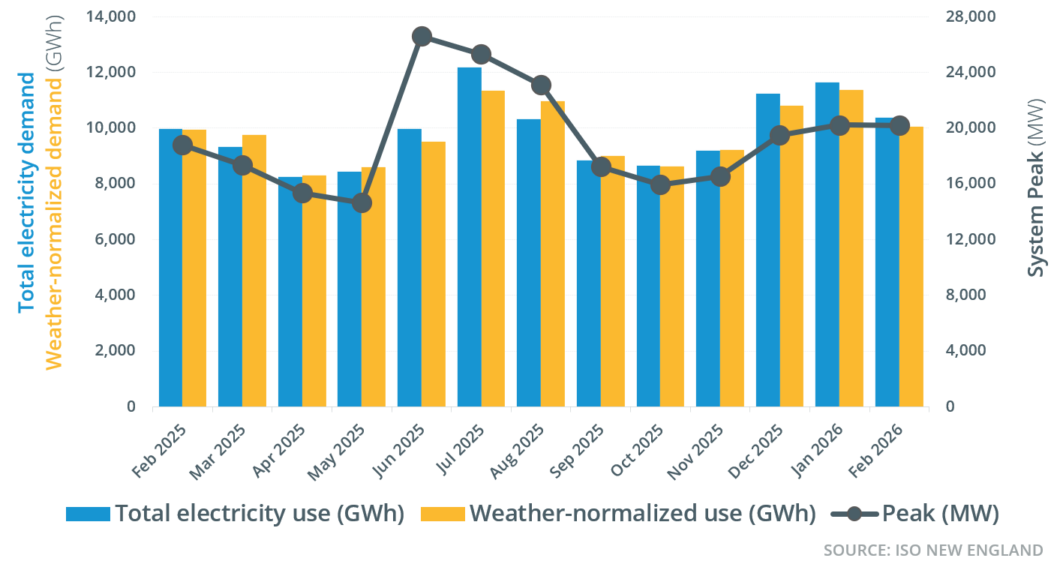
Demand is driven primarily by weather, as well as economic factors. Energy usage during February increased 4.1% to 10,368 GWh from the 9,960 GWh used in February 2025. The average temperature during February was 26˚ Fahrenheit (F) in New England, down 3˚ from the previous February. The average dew point, a measure of humidity, was 15˚F in February, down 2˚ from the previous February. There were no cooling degree days (CDD) during February, which is normal for New England.4 In February 2025, there were also no CDD. There were 1,097 heating degree days (HDD) during February, while the normal number of HDD in February is 1,010 in New England. In February 2025, there were 1,013 HDD.
Consumer demand for electricity for the month peaked on Feb. 8 during the hour from 5:00 to 6:00 p.m., when the temperature in New England was 13°F and the dewpoint was −6°. Demand reached 20,178 MW. The February 2026 peak was 7.5% higher than the February 2025 peak of 18,773 MW, set during the hour from 6:00 to 7:00 p.m. on Feb. 18, when the temperature was 21°F and the dewpoint was 3°.
Peak demand is driven by weather, which drives the use of heating and air conditioning equipment. The all-time high winter peak was 22,818 MW, recorded during a cold snap in January 2004 when the temperature was −1°F and the dewpoint was −20°. The all-time peak demand in New England was 28,130 MW, recorded during an August 2006 heat wave, when the temperature was 94°F and the dewpoint was 74°. Air conditioning use is far more widespread than electric heating in New England, so weather tends to have a relatively greater impact on the summer peak than the winter peak.
Monthly peak demand and total and weather-normalized energy use
Resource mix and emissions

The mix of resources used in any given time period depends on price and availability, as well as supplemental resource commitments needed to ensure system stability. Natural-gas-fired and nuclear generation produced about 75% of the 8,654 GWh of electric energy generated within New England during February, at about 49% and 26%, respectively. Renewable resources generated about 13% of the energy produced within New England, including 4.8% from wood, refuse, and landfill gas; 5.2% from wind; and 2.5% from solar resources. Coal resources generated 0.0% while oil-fired resources generated 7.3%. Hydroelectric resources generated 4.7%. The region also received net imports of about 1,889 GWh of electricity from neighboring regions.
The mix of resources used to produce the region’s electricity is a key driver of carbon dioxide (CO2) emissions. The ISO estimates these emissions through an analysis that blends data on electricity generation by fuel type with an emissions factor for each fuel that is based on data from the Environmental Protection Agency.5
February estimated CO2 emissions in New England, by fuel source (metric tons)

New England power plants produced an estimated 2.61 million metric tons of CO2 in February 2026, an approximately 20% increase from the previous February.
Estimated CO2 emissions from natural-gas-fired plants — typically the region’s largest source of power system emissions, due to the significant amount of electricity these resources produce — increased 5% year over year, at approximately 86,167 metric tons. These resources accounted for 63% of the power system’s total emissions.
Together, oil- and coal-fired resources produced an estimated 484,755 metric tons of CO2 in February 2026 (around 19% of the total), up from an estimated 127,694 metric tons in February 2025. Because the region’s wholesale electricity markets select the lowest-priced resources needed to meet demand, oil- and coal-fired resources tend to run more frequently when natural gas prices rise, and less frequently when natural gas prices are low.
CO2 emissions from other resources — mostly refuse and wood — were estimated at 467,929 metric tons, a 3% decrease from February 2025. These resources accounted for about 18% of the power system’s estimated CO2 emissions for the month.
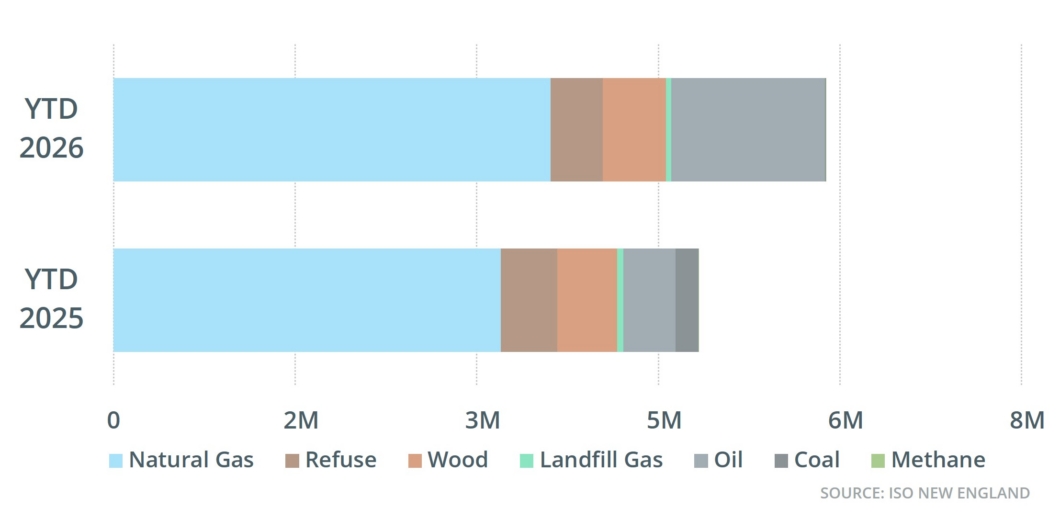
Estimated year-to-date emissions through Feb. 28 increased 22% year over year. The increase in emissions was largely driven by a cold snap that lasted from Jan. 23 to Feb. 10.
High demand, coupled with limited pipeline availability into New England, drove higher natural gas prices, and many generators used oil as a more economical alternative. January’s Winter Storm Fern left solar panels under a layer of snow, limiting performance of behind-the-meter solar. Neighboring regions also experienced extreme cold and its related effects at the same time, reducing imports into New England.
Regional CO2 average annual emissions from electric generation have declined significantly in the last decade. The ISO New England Electric Generator Air Emissions Reports provide a more comprehensive analysis of New England electric power generator air emissions and a review of relevant system conditions.
February year-to-date estimated CO2 emissions in New England, by fuel source (metric tons)
1. One megawatt (MW) of electricity can serve about 750 to 1,000 average homes in New England. A megawatt-hour (MWh) of electricity can serve about 1,000 homes for one hour. One gigawatt-hour (GWh) can serve about 1 million homes for one hour.
2. Weather-normalized demand indicates how much electricity would have been consumed if the weather had been the same as the average weather over the last 20 years.
3. A British thermal unit (Btu) is used to describe the heat value of fuels, providing a uniform standard for comparing different fuels. One million British thermal units are shown as MMBtu.
4. A degree day is a measure of heating or cooling. A zero-degree day occurs when no heating or cooling is required; as temperatures drop, more heating days are recorded; when temperatures rise, more cooling days are recorded. The base point for measuring degree days is 65 degrees. Each degree of a day’s mean temperature that is above 65 degrees is counted as one cooling degree day, while each degree of a day’s mean temperature that is below 65 degrees is counted as one heating degree day. A day’s mean temperature of 90 degrees equals 25 cooling degree days, while a day’s mean temperature of 45 degrees equals 20 heating degree days.
5. The factors used to calculate estimated CO2 emissions were updated in October 2025. ISO New England analysts regularly review and refine the methodology used to develop these emissions factors, in order to reflect the characteristics of New England’s generating fleet and improve the accuracy of the estimates.

Historical weather data provided by DTN, LLC. Underlying natural gas data furnished by ICE.
- Categories
- Inside ISO New England
- Tags
- monthly prices