


Explainer: Why are energy prices sometimes negative?
You can’t get something for nothing. So why is it that wholesale electric energy prices are sometimes zero, or even less?
There are a lot of factors involved, but they boil down to a simple economic concept: surplus. When New England’s bulk power system has more electricity than consumers need, the value of that electricity drops. By the same token, prices climb higher when energy is scarce.
Negative prices haven’t had a dramatic effect on overall wholesale electricity costs. They occur primarily in the Real-Time Energy Market, but they are rare in the Day-Ahead Energy Market, where the majority of the region’s energy transactions take place. In 2025, real-time energy prices averaged $65.88 per megawatt-hour — comparable to the day-ahead average for the year.
Transitory conditions
ISO New England uses a process called economic dispatch to select the lowest-priced resources necessary to meet consumer demand for electricity at any given moment. For brief periods and under the right conditions, it’s possible for demand to be fully satisfied by energy offered at negative prices.
Negative prices can occur at any time, depending on power system conditions. They’re most common around midday. This is especially true in the springtime, when demand for grid electricity tends be lower as a result of mild temperatures and contributions from behind-the-meter solar. Data from April 20, 2025, illustrates this principle. That day set a record for New England’s lowest electricity demand in modern times. Demand was in decline from around 7:30 a.m. until around 2 p.m. Prices fell to zero or less intermittently between 8:30 a.m. and 3:30 p.m. During that time, less expensive resources like grid-connected solar, wind, hydro, and nuclear displaced more expensive resources like natural gas.
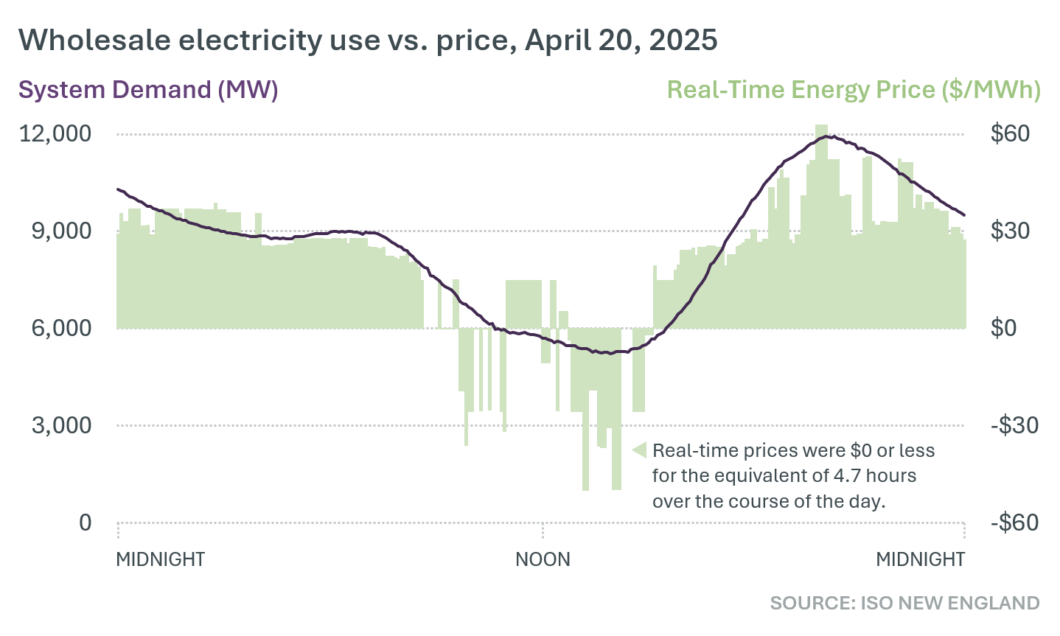
In general, instances of subzero prices are infrequent and short-lived. In 2024, periods of negative prices averaged 17 minutes in duration. Over the course of the year, those negative intervals added up to about 31 hours — a little more than a day’s worth out of 366 days.
Negative prices don’t last very long because the market responds quickly to changing system conditions. When prices drop, resource owners have less incentive to sell electricity, and so they may reduce output. Or, if energy prices are higher in neighboring regions, they may choose to export electricity.
Contributing factors
But how can prices go negative in the first place? That has to do with factors outside the energy markets.
Traditional energy resources need fuel to operate. Resource owners factor their fuel costs into the price at which they offer to produce energy. But wind and solar resources have no fuel costs. They produce energy virtually for free whenever the wind is blowing or the sun is shining. (All resource types cost money to build and maintain, and these costs may also factor into offer prices.)
Many wind and solar resources earn revenue outside the wholesale markets in the form of state power purchase agreements and policy incentives. In such cases, it may be economical for them to sell energy at a negative price. They are essentially paying — rather than being paid — to put energy onto the grid. But even if they lose money in the energy market, they may be able to earn it back, and then some, via contracts or incentives.
Localized effects
The example above uses a representative price for all of New England. But sometimes negative prices are limited to smaller areas. This disparity is usually related to constraints on the transmission system, often in Maine.
At times, certain resources selling electricity at negative prices can fully satisfy local demand, displacing other nearby resources. These displaced resources may be offering their electricity at prices that would clear in the wider regional market, but insufficient transmission capacity prevents them from selling it.
Energy sources
Negative supply offers can come from any type of resource — not only clean energy but also fossil fuels.
A key factor influencing whether a given resource makes a negative offer is fuel availability. When a resource has excess fuel, it’s more likely to make a negative offer.
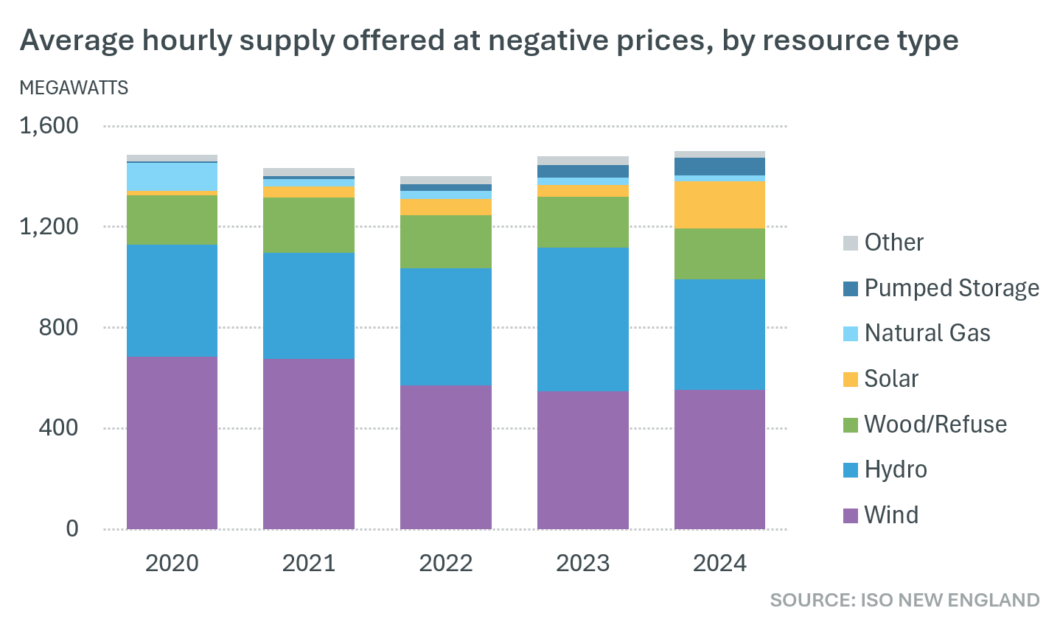
An analysis by the ISO’s Internal Market Monitor shows that, from 2020 to 2024, most offers to sell electricity at negative prices came from wind and hydro resources. What these resources have in common is virtually free “fuel” — blowing winds and rushing rivers. However, the wind does not always blow, and drought conditions can lessen output from hydro resources.
Even though solar facilities have no fuel costs, solar makes up a comparatively small share of negative offers. That’s because most of the region’s solar facilities do not participate in the energy markets. However, the fleet of participating solar installations is growing, as reflected in a greater amount of negative offers in 2024.
Natural gas is New England’s most prevalent resource type, and so the price of electric energy is closely linked to the price of natural gas. But even gas generators make negative offers sometimes. This is usually because they have contracted with gas suppliers to use a certain amount of fuel within a given period.
Future outlook
While instances of negative pricing are relatively rare today, they could increase in frequency as more wind and solar resources enter the markets and as midday demand for grid electricity continues to drop. This could contribute to lower average energy prices, but there may also be downsides.
Evaluation of Pathways to a Future Grid, a 2022 study commissioned by ISO New England and performed by Analysis Group, examined the ability of different market frameworks to meet regional decarbonization goals. It found that, if existing market structures remain in place, negative pricing could occur significantly more often by 2040.
Prolonged periods of negative prices have the potential not only to displace more expensive fossil fuel resources but also resources that don’t emit carbon. This could result in significant “curtailment” — an industry term for wasted energy.
The ISO’s 2024 Economic Planning for the Clean Energy Transition study examined scenarios under which negative prices lead to future market inefficiencies. It also considered possible strategies to reduce curtailment, such as charging electric vehicles and battery storage units during times of surplus generation.
- Categories
- Inside ISO New England
- Tags
- hydro, solar, wholesale prices, wind